
M.D. Medical Director, Psychiatrist
TMS therapy in Salem begins with an evaluation and a one-time brain mapping session, followed by treatments five days a week for four to six weeks. Each session lasts about 20 to 40 minutes, requires no anesthesia or sedation, and you drive yourself home afterward. Most patients who respond notice changes somewhere between weeks two and four. BestMind’s Salem clinic is at 2480 Liberty Street NE, Suite 110.
If you’ve been told TMS might be a good option, you probably left that conversation with the clinical summary and none of the practical detail. What does the room look like? Does it hurt? What do I do while I am getting treatment? When will I know if it’s working?
This is that detail, in order, for patients treating at our Salem clinic.
Before you start: the evaluation
Nothing begins until a licensed psychiatric provider reviews your history and confirms that TMS is the right fit. Expect a conversation about your symptoms, how long they’ve lasted, your medication history, any other diagnoses, and your general medical history — including anything metallic implanted near your head, and any history of seizures.
Bring your medication list. Every antidepressant you’ve tried, roughly what dose, roughly how long, and why you stopped. Two reasons this matters: it’s a clinical question, and it’s also the substance of the insurance prior authorization. If you’re reconstructing from memory, your pharmacy can usually print a fill history going back years.
Most insurance criteria look for a major depressive disorder diagnosis plus documented inadequate response to two or more medication trials — the pattern clinicians call treatment-resistant depression.
Day one: brain mapping
Your first visit in the chair isn’t a treatment. It’s calibration, and it’s the reason TMS is targeted rather than approximate.
The first step for individualized treatment, the provider measures to the treatment target: an area of the prefrontal cortex involved in mood regulation. These coordinates are recorded and reused every session, so day 14 lands in the same place as day 1.
The last step is determining your motor threshold — the lowest amount of magnetic stimulation that produces a small involuntary twitch in your hand. It’s a strange thing to watch happen to your own thumb, and it’s harmless. That threshold becomes the reference point for your treatment dose, so the energy you receive is scaled to your individual physiology rather than to an average.
Mapping may take longer than a normal session — plan on an hour or so. Our post on brain mapping for TMS goes deeper if you want the mechanics.
What a session is actually like
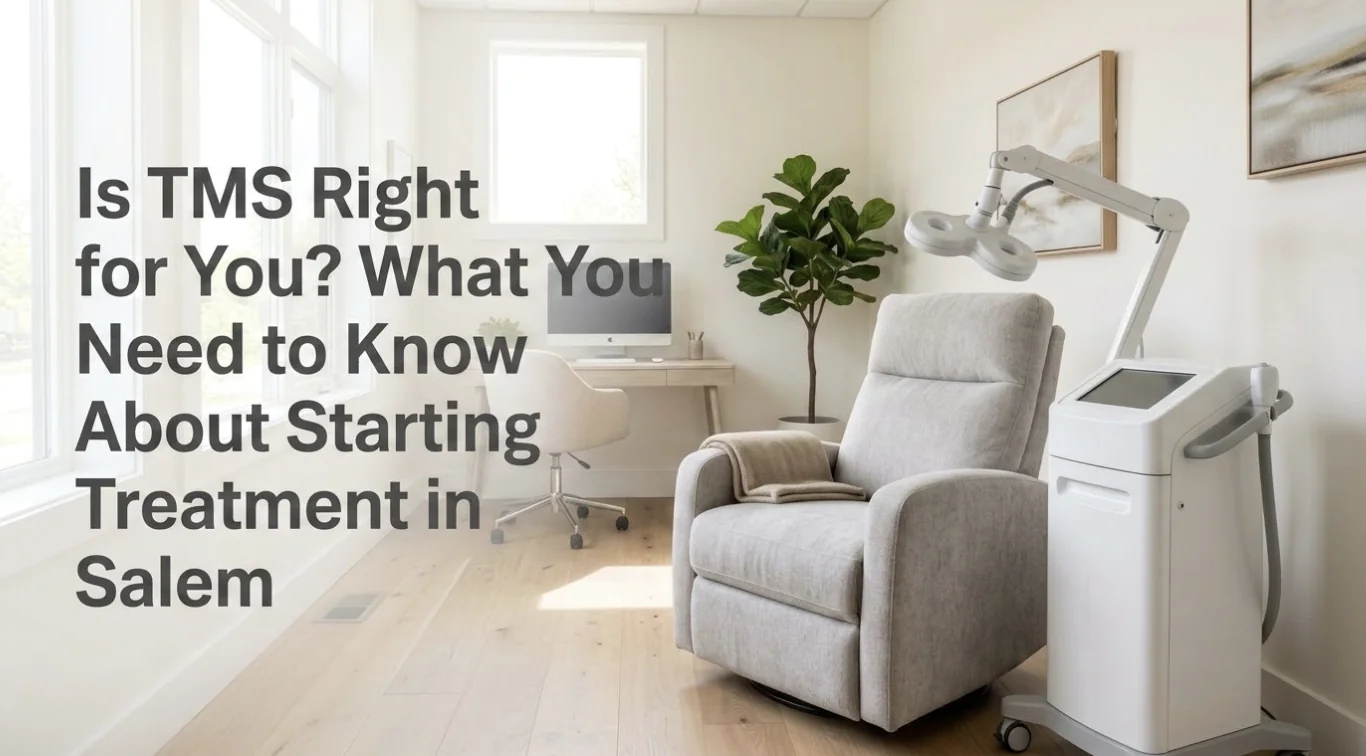
You sit upright in a chair that looks like a slightly overbuilt recliner. You stay in your own clothes. A technician positions the coil against your scalp and confirms placement.
Then the pulses start. The sensation is a rapid tapping on one spot of your head, paired with a clicking sound — you’ll wear earplugs. It comes in bursts of a few seconds with short pauses between, which is why patients often describe the rhythm as the thing they get used to first.
About 20 to 40 minutes, five days a week. You’re awake the entire time, and you can talk to the technician throughout. Most people read, listen to a podcast, or watch something. A fair number nap, which is allowed as long as your head stays in position.
When it’s over, you stand up and leave. No anesthesia, no sedation, no recovery period, no driving restriction. This is the single biggest practical difference between TMS and electroconvulsive therapy, and it’s why TMS fits into an ordinary week.
Studies show improved outcomes with 5 minutes of TaiChi prior to each session to provide a calm brain for optimal stimulation. After each session, engaging in calm, positive thoughts for an hour allows for the TMS-induced neuroplastic brain to remodel away from the dark thoughts and habits.
Side effects, honestly
The common one: mild scalp discomfort or tenderness at the treatment site during the session. It’s the most frequently reported side effect, and for most people it eases over the first week or two as they acclimate. Headache after a session is also fairly common early on and typically responds to over-the-counter pain relief.
What TMS avoids: because it’s targeted rather than systemic, TMS doesn’t produce the side effects that lead people to quit antidepressants — weight gain, drowsiness, sexual dysfunction, cognitive dulling. For a lot of patients, that trade is the whole appeal.
The rare one: seizure is a rare risk, which is why seizure history and certain medications are screened at evaluation. Our full breakdown of TMS side effects covers the details.
If something bothers you, say it out loud in the chair. Coil position and intensity can often be adjusted.
The week-by-week arc
Averages, not promises — the actual pattern varies a lot between people.
Week 1 — adjustment. You’re getting used to the sensation and the logistics. Scalp tenderness is usually at its peak. Almost nobody feels mood change this early. The main job is showing up.
Week 2 — the noticing usually starts here. Often not as “I feel happy” but as something structural: sleeping through the night, waking without dread, finishing a task you’d been circling for a month. People frequently report that someone else noticed first.
Weeks 3–4 — accumulation. This is where change tends to become unmistakable, and also where the treatment gets tedious. You’re 15 to 20 sessions in, the novelty is gone, and the drive to Liberty Street is just a thing you do now. Completion matters clinically, and this is the stretch where people are most tempted to skip.
Weeks 5–6 — consolidation, and taper. Most courses run 30 to 36 sessions, often finishing with a taper — sessions stepping down from five a week to three, then two, then one. The taper isn’t padding; it’s part of the protocol. See how many TMS treatments are needed for the full range.
If nothing has shifted by week 4, tell your provider rather than waiting for the course to end. Coil position, intensity, and protocol can be adjusted, and there are other options if standard TMS isn’t producing a response.
After the course
TMS isn’t a permanent rewiring, and it isn’t a one-time cure. Some people stay well for years. Some experience a return of symptoms months or years later and complete a second course, which insurance often covers for patients who responded the first time. Some continue occasional maintenance sessions.
Most patients also stay on medication management alongside and after TMS. The two aren’t in competition.
Practical notes for Salem patients
Our Salem clinic is at 2480 Liberty Street NE, Suite 110, Salem, OR 97301, open Monday through Friday, 8:00 a.m. to 5:00 p.m., serving Salem, Keizer, Silverton, Stayton, and surrounding Willamette Valley communities.
Two things worth planning around when you’re committing to 30-plus visits:
Pick your time slot strategically. For the many Salem patients working state or county schedules downtown, a consistent 8:00 a.m. or 4:15 p.m. slot is easier to protect than a floating midday appointment. Ask what’s available before authorization goes through, not after.
Factor in the drive if you’re coming from Silverton, Stayton, or Keizer. Twenty extra minutes each way is manageable once; across 30 sessions it’s about twenty hours. That’s not a reason to skip treatment — it’s a reason to schedule around traffic and to be honest with yourself about the commitment up front.
Salem also offers Spravato treatment, ADHD testing and telehealth appointments, so follow-up medication visits don’t have to be another trip.
Getting started
Call (971) 300-0654 or request an appointment through our Salem scheduling page. Full details are on the Salem location page.
Six weeks is a real commitment. It’s also finite — which is a genuinely different thing from a depression that has no end date attached to it.
If you are in crisis, call or text 988 to reach the 988 Suicide & Crisis Lifeline, available 24/7.
Frequently Asked Questions
What happens at your first TMS appointment?
The first visit in the chair is brain mapping rather than treatment. The provider measures the treatment target in the prefrontal cortex and records those coordinates for every future session. The provider locates your motor threshold — the lowest stimulation that produces a small involuntary twitch in your hand — and uses it to scale your treatment dose. This process can take minutes to up to an hour.
Does TMS therapy hurt?
The sensation is a rapid tapping on one spot of the scalp along with a clicking sound, and earplugs are worn. Mild scalp discomfort at the treatment site is the most commonly reported side effect and usually eases over the first week or two. Headache after early sessions is also fairly common and typically responds to over-the-counter pain relief.
How soon does TMS start working?
Most patients who respond notice changes somewhere between weeks two and four, often as improved sleep, less morning dread, or renewed capacity to finish tasks rather than as a sudden lift in mood. If nothing has shifted by week four, tell your provider — position, intensity, and protocol can be adjusted, and other options exist.
Can I drive myself home after a TMS session?
Yes. TMS involves no anesthesia or sedation and there is no recovery period or driving restriction. Patients typically return directly to work or home after a session.
How many TMS sessions will I need?
A standard course runs five days a week for four to six weeks, usually 30 to 36 sessions total, often ending with a taper that steps down from five sessions a week to three, then two, then one. The taper is part of the protocol rather than optional padding.
Where is TMS therapy available in Salem, Oregon?
BestMind Behavioral Health offers TMS therapy at 2480 Liberty Street NE, Suite 110, Salem, OR 97301, open Monday through Friday from 8:00 a.m. to 5:00 p.m. The clinic serves Salem, Keizer, Silverton, Stayton, and surrounding Willamette Valley communities. Call (971) 300-0654 to schedule.
