
M.D. Medical Director, Psychiatrist
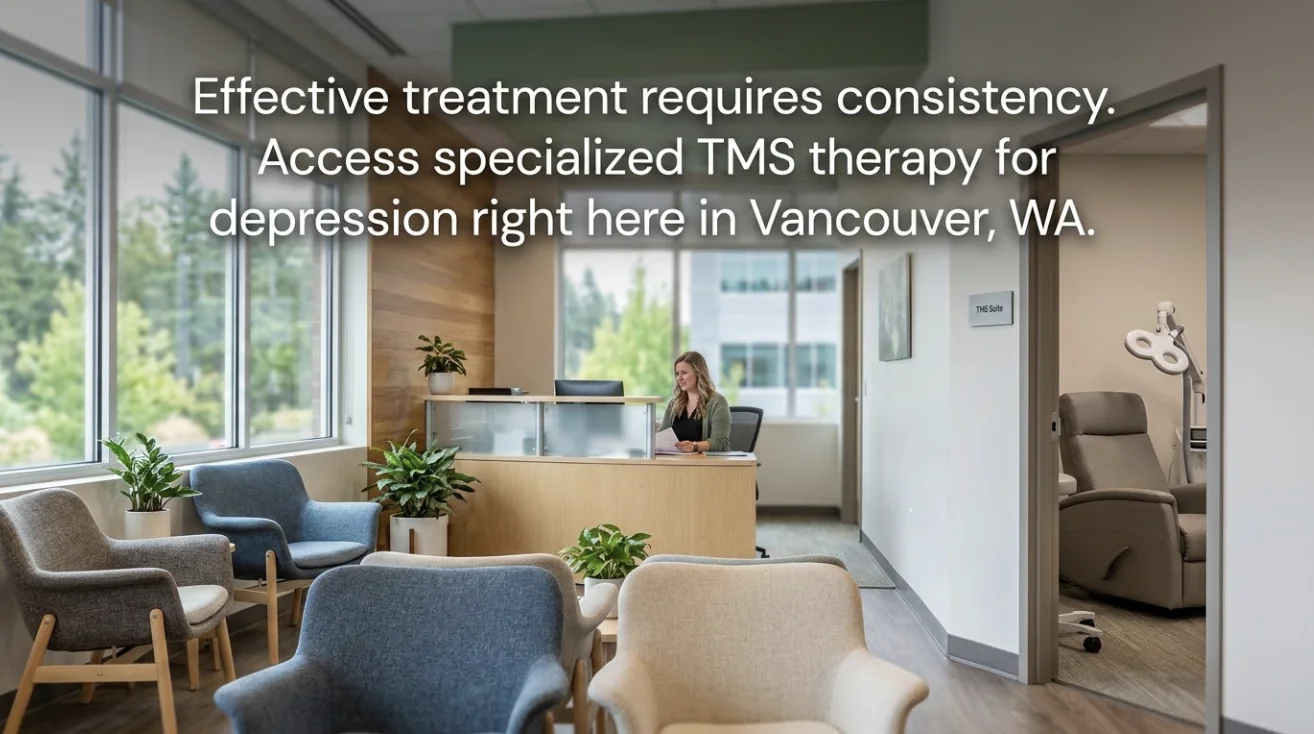
TMS therapy is available in Vancouver, WA at BestMind Behavioral Health, 8501 E Mill Plain Blvd. Sessions run about 20 to 40 minutes, five days a week for four to six weeks, with no anesthesia and no recovery time. Washington plans including Premera Blue Cross, Regence BlueShield, Aetna, Cigna, Providence, Humana, and United Healthcare are accepted, and TMS is covered by most plans for patients who meet criteria.
For a long time, “specialty psychiatric care in Southwest Washington” meant a trip across the Columbia.
If you’ve done that drive for a recurring appointment, you know exactly what it costs. The I-5 bridge at the wrong hour, the interstate math of leaving at 3:40 to make a 4:15, the low-grade dread of the return trip. Once a month, that’s an annoyance. For a treatment that runs five days a week for four to six weeks, it’s the reason a lot of people never start.
TMS therapy is available on the Washington side. Here’s what that involves.
What TMS is, briefly
Transcranial magnetic stimulation delivers gentle, MRI-strength magnetic pulses to a mapped area of the brain involved in mood regulation. It has been cleared by the FDA for treating major depressive disorder since 2008.
It’s most often used for adults whose depression hasn’t improved adequately with antidepressant medication. There’s no anesthesia and no sedation — you sit upright in a chair, awake, in your own clothes, and drive yourself home afterward. Our TMS therapy page covers the mechanism, and our what-to-expect walkthrough covers the timeline of a typical course.
The practically relevant facts:
– 20 to 40 minutes per session
– Five days a week for four to six weeks
– No recovery period, no driving restriction — most patients go straight back to work – Most common side effect: mild scalp discomfort during the session, which usually eases over the first week or two
Washington insurance: what actually applies
This is where Southwest Washington genuinely differs from Portland, and where a lot of online information will lead you wrong. Oregon Health Plan content doesn’t apply to you. Neither does most Oregon-specific coverage guidance.
Our Vancouver clinic accepts Cigna, Cigna Medicare, UHC, UHC Medicare, Optum, Premera (Anthem/Regence/BCBS), AETNA, Humana, Providence, Medicare, Molina (Managed Medicaid Plan), Provider Network of America, WHA Apple Health (THIS DOES NOT INCLUDE MANAGED CARE PLANS), Well Point (Commercial/Medicare and Medicaid), and Devoted. Premera and Regence in particular are Washington-specific plans you won’t see on an Oregon clinic’s list — worth noting if you’ve been comparing options across the river.
Three things to know about TMS coverage in Washington:
Prior authorization is standard. Essentially every commercial plan requires it for TMS. This is paperwork, not a barrier — our team assembles and submits it.
The criteria are about your medication history. Most plans want a major depressive disorder diagnosis plus documented inadequate response to two or more antidepressant trials at adequate dose and duration. Some also want a documented trial of psychotherapy. That pattern — depression that hasn’t responded to multiple medications — is what clinicians call treatment-resistant depression.
Apple Health (Washington Medicaid) is a separate question. Coverage for TMS under Apple Health depends on your managed care organization and current state policy, and it’s genuinely different from commercial coverage. Don’t assume either direction — call (360) 295-9077 and ask about your specific plan before you plan around it.
Our insurance page lists current accepted plans, and our guide to insurance coverage for TMS therapy walks through the authorization process in detail.
Preparation tip that matters more than any other: before your evaluation, write down every antidepressant you’ve tried, the approximate dose, how long you took it, and why you stopped. This list is both the clinical conversation and the authorization submission. Vague recall is the single most common cause of delay. Your pharmacy can print a fill history going back years if you need help reconstructing it.
Why treating locally changes the odds
There’s a clinical argument here, not just a convenient one.
TMS works best when you complete the course. Thirty-plus sessions is a lot of appointments, and the strongest predictor of finishing is how hard each individual visit is to get to. A treatment that requires crossing the Columbia at rush hour five days a week for six weeks has a meaningfully higher chance of being abandoned in week three than one fifteen minutes from home.
Our Vancouver clinic at 8501 E Mill Plain Blvd, Vancouver, WA 98664 is open Monday through Friday, 8:00 a.m. to 5:00 p.m., serving Vancouver, Camas, Washougal, and the greater
Southwest Washington region. For most of east Vancouver, Camas, and Washougal, that’s a short local drive with no bridge in it.
Two scheduling notes specific to a course this long:
Lock a consistent slot. If you commute into Portland for work, a 4:15 p.m. session on the Washington side means you’re heading north against the evening flow rather than sitting in it. Ask about first-slot and last-slot availability before authorization goes through.
Ask about the whole calendar up front. Six weeks of weekday appointments will intersect with something — a work trip, a holiday, a school schedule. Better to map that in the first conversation than to improvise in week four.
If TMS isn’t the right fit
It isn’t for everyone, and there are other options in the same building with the same team.
Esketamine (SPRAVATO®) is a nasal spray treatment for treatment-resistant depression, administered in-clinic with a two-hour monitoring period after each dose. Different mechanism, different schedule, similar target population.
Medication management — sometimes the answer is that you haven’t yet had a genuinely optimized medication trial. Not every patient who’s been on four antidepressants has been on four adequate trials, and a careful review sometimes reveals a straightforward next step.
Telehealth for ongoing follow-up visits, which are available to anyone physically located in Washington.
ADHD testing — worth mentioning because untreated ADHD is a common contributor to depression that hasn’t responded well to antidepressants alone.
How to start
- Call (360) 295-9077 or request an appointment through our Vancouver in-person scheduling page.
- Bring your medication history to the evaluation.
- Ask three questions: do I meet my plan’s criteria, what will my per-session cost be, and what appointment times are actually available for a six-week course.
Full details, directions, and hours are on our Vancouver location page.
If medication hasn’t worked and you’d written off TMS because of the drive — the drive is no longer the answer to that question.
If you are in crisis, call or text 988 to reach the 988 Suicide & Crisis Lifeline, available 24/7.
Frequently Asked Questions
Is TMS therapy available in Vancouver, WA?
Yes. BestMind Behavioral Health provides TMS therapy at 8501 E Mill Plain Blvd, Vancouver, WA 98664, open Monday through Friday from 8:00 a.m. to 5:00 p.m. The clinic serves Vancouver, Camas, Washougal, and the greater Southwest Washington region. Call (360) 295-9077 to schedule.
Does Washington insurance cover TMS therapy?
TMS is covered by most plans for patients who meet criteria, which typically means a major depressive disorder diagnosis plus documented inadequate response to two or more antidepressant trials. Prior authorization is essentially always required. BestMind’s Vancouver clinic accepts Cigna, Cigna Medicare, UHC, UHC Medicare, Optum, Premera (Anthem/Regence/BCBS), AETNA, Humana, Providence, Medicare, Molina, Provider Network of America, WHA Apple Health, Well Point, and Devoted.
Does Apple Health cover TMS therapy in Washington?
Coverage for TMS under Apple Health, Washington’s Medicaid program, depends on your managed care organization and current state policy, and it differs from commercial coverage. Call (360) 295-9077 to ask about your specific plan rather than assuming either way.
How long does a course of TMS therapy take?
Sessions last about 20 to 40 minutes and run five days a week for four to six weeks. There is no anesthesia, no sedation, no recovery period, and no driving restriction, so most patients return directly to work or home afterward.
Do I have to go to Portland for TMS if I live in Vancouver?
No. TMS is available on the Washington side at BestMind’s Vancouver clinic. Because a full course involves 30 or more weekday appointments, treating locally removes the I-5 bridge from the equation, which matters for completing the course — and completion is what the treatment depends on.
What are the alternatives if TMS isn’t right for me?
The Vancouver clinic also offers esketamine (SPRAVATO) treatment for treatment-resistant depression, psychiatric medication management, ADHD testing, and telehealth appointments for patients physically located in Washington.
