
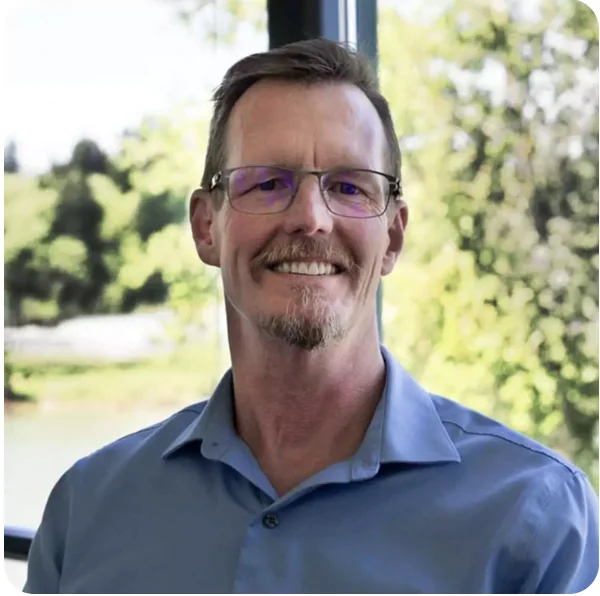
M.D. Medical Director, Psychiatrist
The most common reason people in Beaverton put off TMS therapy isn’t skepticism about whether it works. It’s the schedule.
Five days a week for four to six weeks sounds, on paper, like a leave of absence. For someone commuting to a Sunset Corridor campus or managing a hybrid schedule out of Cedar Mill, that math seems to rule it out before the clinical question is even on the table.
It usually doesn’t. But it’s a fair question, and it deserves a real answer rather than a brochure.
First: what TMS actually is
Transcranial magnetic stimulation delivers gentle, MRI-strength magnetic pulses to a specific area of the brain involved in mood regulation. It has been cleared by the FDA for the treatment of major depressive disorder since 2008. The magnetic pulse causes brain neurons to become excited which induces positive changes (neuroplasticity and improved metabolism) in the deeper parts of the brain that control emotions.
It is not electroconvulsive therapy. There’s no anesthesia, no sedation, and no seizure induced. You sit upright in a chair, awake, in your own clothes. You can talk, listen to music, or watch something. When the session ends, you drive yourself home or back to the office.
Before treatment starts, a provider performs brain mapping to locate the precise target and calibrate the dose to your individual motor threshold. That’s a one-time setup step, and it’s part of why TMS is more targeted than a systemic medication. Our TMS therapy page covers the mechanism in more detail.
The scheduling question, answered honestly
A session takes about 20 to 40 minutes. Add ten minutes on either end and you’re looking at roughly an hour, door to door, for most Beaverton-area patients.
Sessions run five days a week for four to six weeks. That’s the standard course. So the real commitment is about an hour a day, weekdays, for roughly a month and a half.
Here’s what makes it workable:
No recovery time. This is the part people don’t expect. TMS has no sedation and no cognitive fog afterward, so you go straight back to work. The most commonly reported side effect is mild scalp discomfort during the session itself, and it typically fades over the first week or two of treatment. There’s no driving restriction.
Early and late slots exist. Our Beaverton office is open Monday through Friday, 8:00 a.m. to 5:00 p.m. A 7:45 arrival for an 8:00 session puts most people at their desk by 9:15. Ask about first-slot and last-slot availability when you schedule — they’re the ones that go fastest, precisely because everyone wants them.
It’s a defined endpoint. Unlike a medication you may take for years, a TMS course has a finish line. Six weeks of inconvenience for a treatment that ends is a different proposition than an indefinite one.
It’s protected time, legally speaking. TMS for major depressive disorder is medical treatment. If you need a schedule accommodation, that’s a conversation with HR that has legal footing behind it (Family and Medical Leave Act: FMLA). You don’t have to disclose your diagnosis to request one.
Who TMS is actually for
TMS is generally considered for adults with major depressive disorder whose symptoms haven’t improved adequately with antidepressant medication. In practice, most insurance criteria look for documented inadequate response to two or more medication trials at an adequate dose and duration.
That’s a description that fits a lot of people who don’t know it fits them. If you’ve been on three or four antidepressants over eight years, currently take one that takes the edge off without actually lifting the depression, and have quietly concluded that this is simply your baseline — you’re describing treatment-resistant depression, which is a recognized clinical situation with its own treatment pathway, not a personal ceiling. Typically if an antidepressant medication is working, it should show benefit within 6-8 weeks after when at an adequate dose.
TMS is also frequently a good fit for people who can’t tolerate antidepressant side effects. Because it’s targeted rather than systemic, TMS avoids the effects that lead people to abandon medication — weight gain, drowsiness, tremor, sexual dysfunction, and cognitive dulling.
Qualification is confirmed in an evaluation with a licensed psychiatric provider who reviews your history and symptoms. Our post on who qualifies for TMS therapy walks through the criteria in detail.
Does it work?
Across BestMind’s own patient population, internal outcome data from June 2022 through April 2025 showed a 72.99% response rate and a 51.38% remission rate for TMS. Typical remission rate for antidepressants is 28% for first medication tried, 21% for second medication tried, 16% for third trial and 7% chance of remission from fourth medication trial, per STAR*D research.
Two words worth defining, because they get used loosely: response generally means a clinically meaningful reduction in depression symptoms — typically at least 50%. Remission means symptoms have dropped to a level no longer consistent with active depression.
Those are strong numbers for a population that, by definition, has already not responded to medication. They’re also population averages, not a prediction about any individual, and a provider who tells you otherwise is overselling.
Why treat in Beaverton rather than downtown
Practical, but it matters when you’re doing this five days a week for six weeks.
Our Beaverton clinic at 1925 NE Stucki Avenue, Suite 270 sits on the west side, with surface parking and no downtown parking structure to navigate. For patients coming from Hillsboro, Aloha, Cedar Mill, Cedar Hills, Tigard, Tualatin, Lake Oswego, Sherwood, Forest Grove, Cornelius, or North Plains, it’s a materially shorter trip than crossing into central Portland — and over a 30-session course, twenty minutes of saved drive time each way adds up to roughly ten hours.
Compliance is a real clinical variable in TMS and the more pulses you get with treatment, the better the results. The course works best when you complete it, and the single biggest predictor of completion is how easy it is to get there.
The Beaverton office also offers medication management, esketamine (SPRAVATO®), and ADHD testing, so if TMS turns out not to be the right fit, the alternatives are in the same building with the same team.
Insurance and cost in Oregon
TMS is covered by most insurance plans for patients who meet criteria. BestMind accepts Aetna, Cigna, ComPsych, Providence, Humana, United Healthcare, Kaiser Permanente, and PacificSource, among others — the current list is on our insurance page.
What to expect from the process:
Prior authorization is standard. Nearly every plan requires it for TMS. Our team assembles and submits the documentation, which typically includes your diagnosis, medication history with doses and durations, and symptom severity.
Your medication history is the deciding document. Vague recall — “some SSRI a few years ago” — slows approvals down more than anything else. Before your evaluation, write down every antidepressant you’ve tried, the approximate dose, how long you stayed on it, and why you stopped. Pharmacy records can help you reconstruct this.
Ask about your specific cost, not the general one. Coverage approval and out-of-pocket cost are separate questions. Get a straight answer on your copay or coinsurance per session, and on whether your deductible has been met, before you start.
How to start
- Call (971) 300-0654 or request an appointment through our Beaverton scheduling page.
- Bring your medication history to the evaluation — this is the single most useful thing you can prepare.
- Ask about early or late session slots if you’re working full time, and ask before authorization goes through so you know what your six weeks will look like.
Full location details, hours, and directions are on our Beaverton location page.
If depression has been running your life for years and medication hasn’t changed that, the question worth asking isn’t whether you can fit six weeks into your schedule. It’s what the last five years have already cost you.
If you are in crisis, call or text 988 to reach the 988 Suicide & Crisis Lifeline, available 24/7.
Frequently Asked Questions
How long does a TMS session take, and how many will I need?
A TMS session takes about 20 to 40 minutes. The standard course runs five days a week for four to six weeks. Most Beaverton-area patients budget about an hour door to door per visit.
Can I work during TMS therapy?
Yes. TMS involves no anesthesia or sedation, so there’s no recovery period and no driving restriction. Most patients return to work immediately after a session. Early-morning and late-afternoon appointment slots make it possible to complete a full course while working full time.
Does insurance cover TMS therapy in Oregon?
TMS is covered by most insurance plans for patients who meet criteria, which typically means a major depressive disorder diagnosis and documented inadequate response to two or more antidepressant trials. Prior authorization is nearly always required, and BestMind’s team submits the documentation. Accepted plans include Aetna, Cigna, ComPsych, Providence, Humana, United Healthcare, Kaiser Permanente, and PacificSource.
Does TMS hurt, and what are the side effects?
The most commonly reported side effect is mild scalp discomfort during the session, which typically fades over the first week or two of treatment. Because TMS is targeted rather than systemic, it avoids common antidepressant side effects such as weight gain, drowsiness, sexual dysfunction, and cognitive dulling.
How effective is TMS therapy?
Across BestMind’s own patient population, internal outcome data from June 2022 through April 2025 showed a 72.99% response rate and a 51.38% remission rate. Response generally means at least a 50% reduction in depression symptoms; remission means symptoms are no longer consistent with active depression. These are population averages, not individual predictions.
What else does the Beaverton office offer besides TMS?
The Beaverton clinic at 1925 NE Stucki Avenue, Suite 270 also offers psychiatric medication management, esketamine (SPRAVATO) treatment, and ADHD testing, Monday through Friday from 8:00 a.m. to 5:00 p.m.
